Phuket, early 2025. At lunchtime the restaurant was fighting for every table: a queue at the door, the hostess handing out paper waiting slips, some people leaving without being seated. By evening the dining room emptied almost instantly. The owner knew exactly how many guests came that day. But who they were — he did not know. Whether they would come back — he did not know either.
This is not an exception. It is the typical picture for the majority of venues in Southeast Asia, even those running modern POS systems.
The POS Sees a Transaction. The Restaurant Loses a Guest
Restaurant management systems — Syrve, iiko and their counterparts — handle operational tasks superbly: take an order, send it to the kitchen, close a check. Over twenty years these platforms have absorbed everything needed to run the floor and the kitchen.
Yes, some POS systems have built-in loyalty modules. Syrve, for example, lets you create a discount card, award bonus points, apply a discount at checkout. But in practice this is bare-minimum mechanics: a fixed discount or a simple points account. No guest profile, no preference history, no automated communications, no digital wallet, no referral programmes. Everything beyond "earn and burn" is outside the POS scope.
And the main blind spot remains: the system sees a transaction, not a guest.
A guest who comes in on Friday evening for the sixth time in a row is, to the POS, just another 850-baht check. The system does not know his name. Does not know he prefers the window seat. Does not know that next month is his birthday and that three weeks ago he recommended the restaurant to two colleagues.
The ResoGuest team ran into this problem while working with several restaurant groups in Thailand. Clients kept asking the same question over and over: "We can see guests leaving after one or two visits. We don't understand why. How do we bring them back?"
The Moment It Became Clear: A Different System Was Needed
In mid-2025 the team ran a data analysis for a four-restaurant chain in Bangkok. The numbers were telling: out of every ten new guests, only two returned within three months. Eight left for good — no explanation, no goodbye.
Meanwhile the venues were spending significant budgets on acquisition: Instagram ads, Line campaigns, discounts through aggregators. The cost of acquiring a single new guest was several times higher than the cost of retaining an existing one. But there were simply no tools for retention.
The market, it turned out, offered two options. The first — Western SaaS loyalty platforms with no integration into local POS systems, requiring manual data synchronisation. The second — custom-built solutions developed for a specific restaurant at tens of thousands of dollars.
Neither option suited mid-scale venues — those that want to operate professionally but lack the budget of a large chain.
The Idea: A Platform That Knows the Guest
Work on ResoGuest began in early 2025. From the start, the concept was built around a single idea: a restaurant should know its guest as well as a good bartender knows a regular.
This meant several things at once.
First, deep integration with real POS systems — above all Syrve, which is widely used by restaurants and chains across Southeast Asia. Not a parallel system but a layer that works on top of the existing operations. Orders from the floor via QR code go straight into the POS. Reservations appear on the terminal. Data is not duplicated manually.
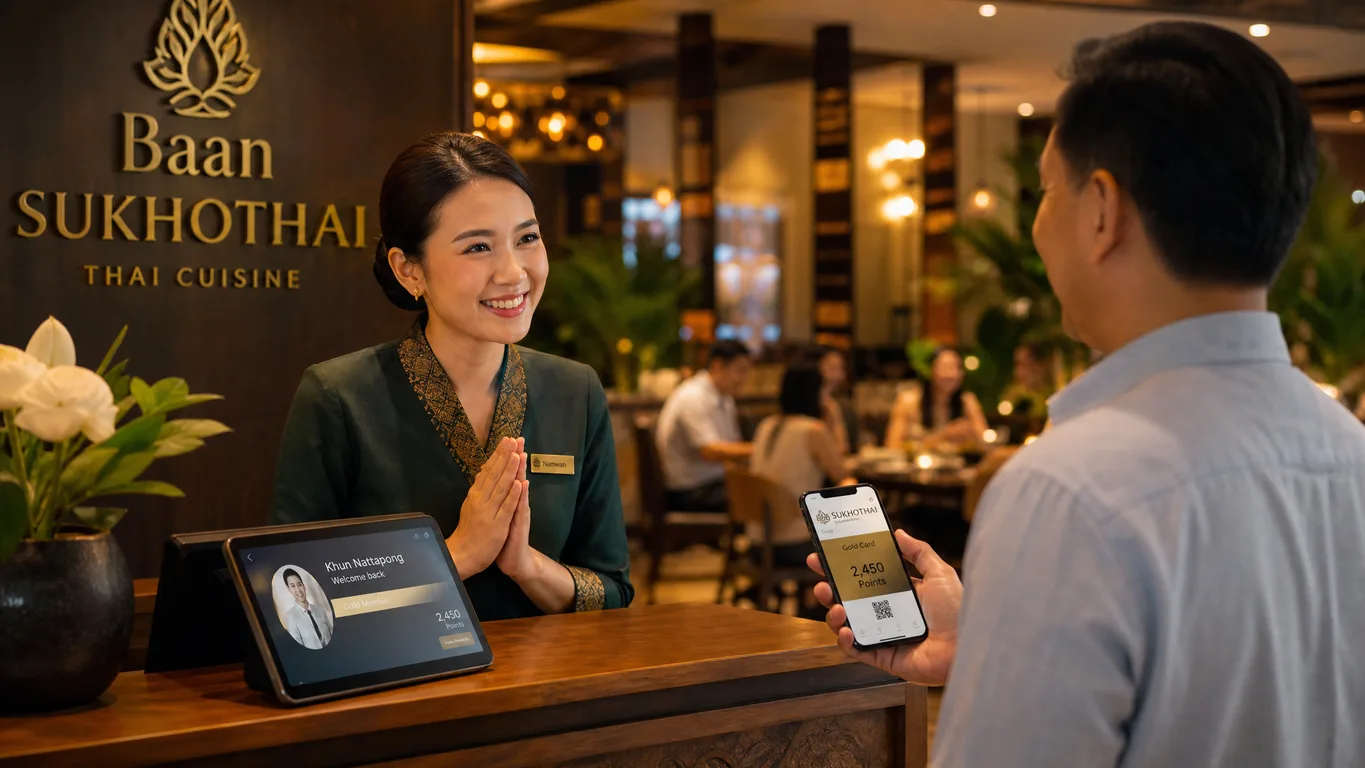
Second, native loyalty — one that works without unnecessary friction. Not a plastic card the guest forgets at home. Not an app that needs to be downloaded. A digital card in Apple Wallet or Google Wallet: add it once and it is always at hand, updates automatically, points are awarded with every visit.
Third, a guest profile that accumulates history: when they visited, what they ordered, how they responded to offers, whom they brought along. Not a set of raw transactions but a living card from which conclusions can be drawn.
Finally, tools for action: automated reminders, personalised birthday offers, win-back campaigns for those who have not visited in a while, referral chains for loyal guests.
What Came Out of It
By autumn 2026 the first venues began working with ResoGuest in pilot mode. The key takeaway confirmed by practice: retention works when it is invisible to the guest and routine for the staff.
The guest does not notice that their profile is updated with every visit. They simply see that they are offered exactly what they like. That they are recognised. That bonus points do not need to be tracked manually — they are just there, ready to be spent right now.
The staff does not maintain extra spreadsheets. The hostess opens the app and sees who has booked and what they prefer. The waiter knows about an upcoming birthday before the guest mentions it.
«ResoGuest is not a POS replacement. It is a layer that turns transactional data into relationships. Because in the restaurant business it is relationships that determine whether a guest comes back or not.»
In upcoming articles we will break down each module of the platform in detail — with specific scenarios, numbers and examples from the practice of Southeast Asian venues.