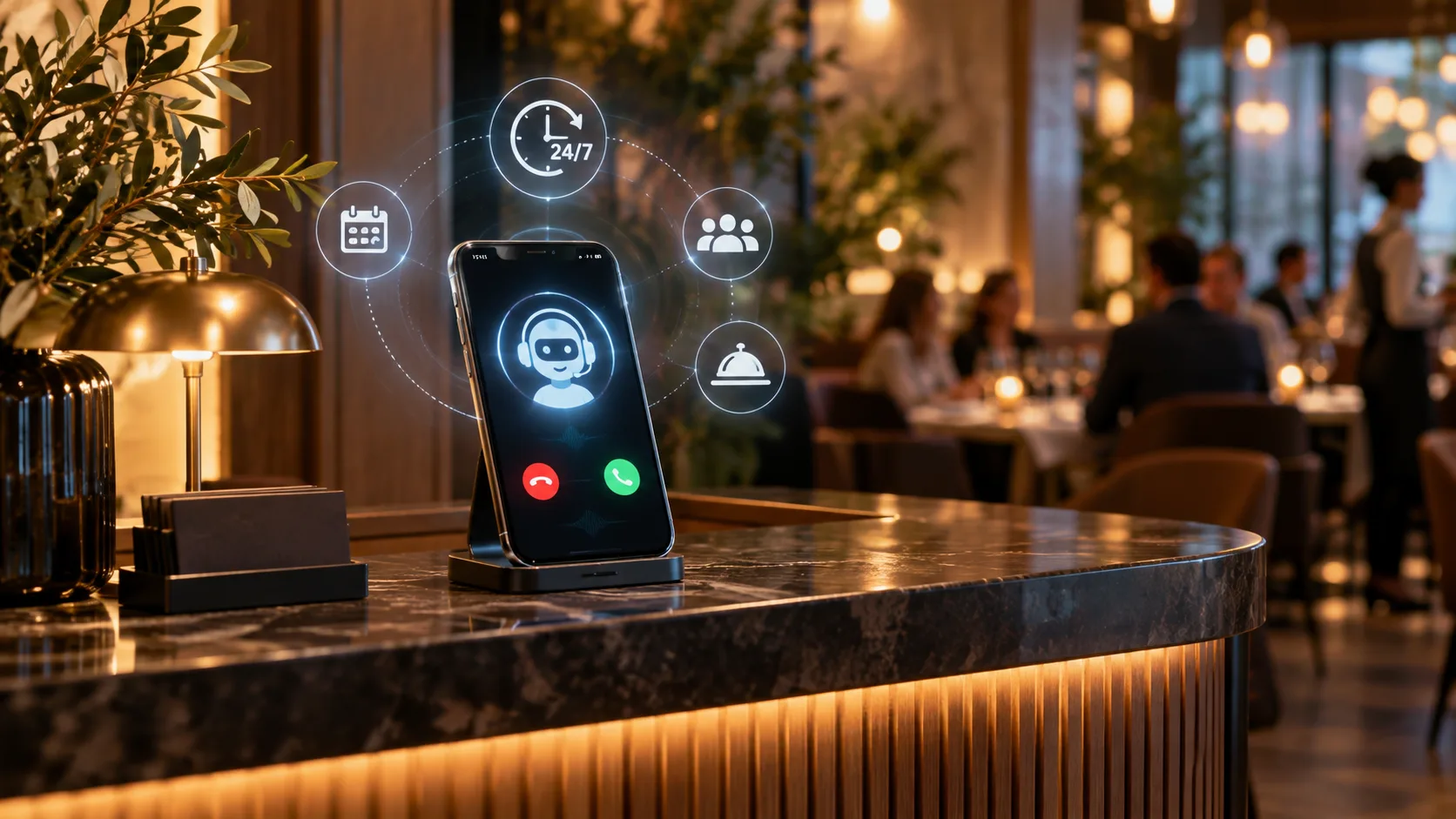
The phone sitting on the counter
Most restaurants do not have a real "call center." Answering the phone is an extra task piled onto someone on the floor — the hostess, a waiter, the shift manager. The phone usually sits on the counter rather than in anyone's hand. During the rush — when calls and guests peak at the same time — there is simply no one available to pick up.
Every manager knows the result: missed calls, which means lost reservations and orders. A guest who gets no answer does not call back — they call the restaurant next door. And you will never find out how much revenue slipped away, because the missed call is recorded nowhere.
On top of this comes the human factor, which hits especially hard on phone calls:
- the staff member answers on the run, distracted, irritated after a difficult guest;
- forgets to write down the reservation, or records the wrong date, time or party size;
- does not know the exact composition of a dish, allergens, what is spicy and what is not — and guesses;
- does not speak a foreign language and loses the international guest in ten seconds;
- on a day off or late at night there is simply nobody to answer.
A live operator is always feast or famine: you either underload someone and pay them to wait, or overload them and lose quality. A dedicated call center for a single restaurant — or even a small group — means payroll, schedules, training and cover for holidays and sick days. The economics only work for large chains.
What the ResoGuest AI assistant does
The voice AI assistant takes phone handling off people entirely. It picks up on the first ring, works around the clock and handles multiple calls in parallel — no queue, no "please hold." It needs no breaks, never gets tired toward the end of a shift, and responds with the same calm politeness to the first guest of the day and the hundredth.
The key difference from a typical "auto-attendant" is that the assistant truly knows your restaurant:
- Knows the full menu. Dish composition, prices, current availability. If you have filled in CPFC data, it can quote calories and macros. It knows which dishes are spicy and warns the guest honestly.
- Sees the floor in real time. With the reservation module connected, the assistant knows the current table layout and load — whether a table is free at the requested time, by the window or in the main room — and never promises a booking it cannot fulfil.
- Books the table and takes the order itself. If the reservation or ordering module is connected, the assistant does not just "take a wish" — it completes the task: creates a reservation for a specific time and party size, or assembles an order — and everything lands in the system instantly, without paper or re-entry.
- Never forgets. Every call is logged: who called, what about, how it ended. No more missed or "forgotten" bookings.
Three languages out of the box — and more on request
In tourist destinations, language is everything. A live staff member is usually confident in one or two languages; an international guest is lost instantly.
The ResoGuest AI assistant already works in three languages. You set the default language in the system settings to match your main audience. If you need to serve guests in an additional language, adding it is a one-time fee that does not affect the ongoing subscription cost. You pay once for the language, then use it with no premium on the monthly bill.
For a restaurant in a resort area, this means you serve local guests and foreign tourists equally well — without hiring multilingual staff.
Comparison: live operator vs. AI assistant
| Parameter | Floor staff / operator | ResoGuest AI assistant |
|---|---|---|
| Availability | During working hours, if free | 24/7, from the first ring |
| Simultaneous calls | One | Multiple in parallel |
| Missed calls | Frequent during rush | Virtually none |
| Menu, CPFC, spice knowledge | "From memory," with errors | Accurate, always up-to-date |
| Table availability | Needs to check, gets distracted | Sees in real time |
| Booking / order entry | Manual, error-prone | Directly into the system |
| Languages | Usually one or two | Three; extra language — one-time fee |
| Human factor | Fatigue, mood, rush | Consistently steady |
| Call logging | Often none | Every call recorded |
What it costs: a live call center vs. AI
The most honest argument is money. Let us do the math on a round-the-clock phone line.
A live 24/7 call center. One operator covers only a single shift (~8 hours), so a non-stop line needs 4–5 people. Factoring in salaries, social contributions, a workstation, telephony, training and turnover, the fully loaded cost of one mid-level operator in Thailand is roughly ฿35,000–45,000/month, and the whole round-the-clock line runs about ฿150,000–220,000/month. And even that does not guarantee every call is answered during the rush.
The ResoGuest voice AI assistant. The "Pro" plan is ฿14,900/month: 2,000 minutes of talk time, 24/7 operation, phone number and telephony on our side, three languages (English, Russian, Thai), call recording, a transcript and a short summary of every conversation. Overage beyond the plan is ฿9/min.
Even several "Pro" plans for a high call volume cost many times less than staffing a round-the-clock line — with no days off, holidays, sick leave or turnover.
Flexible connection options
- Your own telephony (SIP/PBX). If you already have a SIP trunk and +66 numbers, you pay only for AI processing minutes — ฿6/min, with no separate charge for a number or telephony. All the assistant's capabilities are retained.
- Transfer to a manager. The AI handles the routine itself and transfers a complex or conflict conversation to a live staff member. That transfer is billed at ฿1/min and only at the moment of transfer — you do not pay for a "live operator just in case."
- Additional language. Three languages are always included. Need one more (for example, Chinese for tourist traffic from the PRC) — that is a ฿500–1,500/month add-on per language, and the assistant then speaks it with no change to the rest of the cost.
Cost comparison, 24/7
| Option | Cost | What is included |
|---|---|---|
| Live 24/7 call center | ~฿150,000–220,000/mo | 4–5 operators, shifts, some calls still lost |
| AI "Pro" plan | ฿14,900/mo | 2,000 min, 24/7, number, 3 languages, recording + summary |
| AI on your own telephony | ฿6/min | AI minutes only, your own SIP trunk and numbers |
| AI → manager transfer | ฿1/min | billed only at the moment of transfer |
| Additional language | ฿500–1,500/mo | per language beyond the three included |
Who needs this most
- Independent restaurants, where calls "hang" on waiters and the hostess and pull them away from in-house guests.
- Restaurant groups, for whom a full call center is uneconomical, yet losing bookings across all venues is costly.
- Venues in tourist locations, where international guest traffic is high but multilingual staff are rare and expensive.
- Formats with a high share of reservations and pre-orders, where every lost booking is a direct revenue shortfall.
The bottom line
While the phone sits on the counter, the restaurant silently loses money on every missed call. ResoGuest's voice AI assistant turns phone handling from a "burden on staff" into a reliable channel that works around the clock, in three languages, knows your menu and floor plan, and guides the guest all the way to a booking or an order.
This is not a replacement for hospitality on the floor — it is a way to return staff to guests and hand the phone to someone who will never miss a call.