
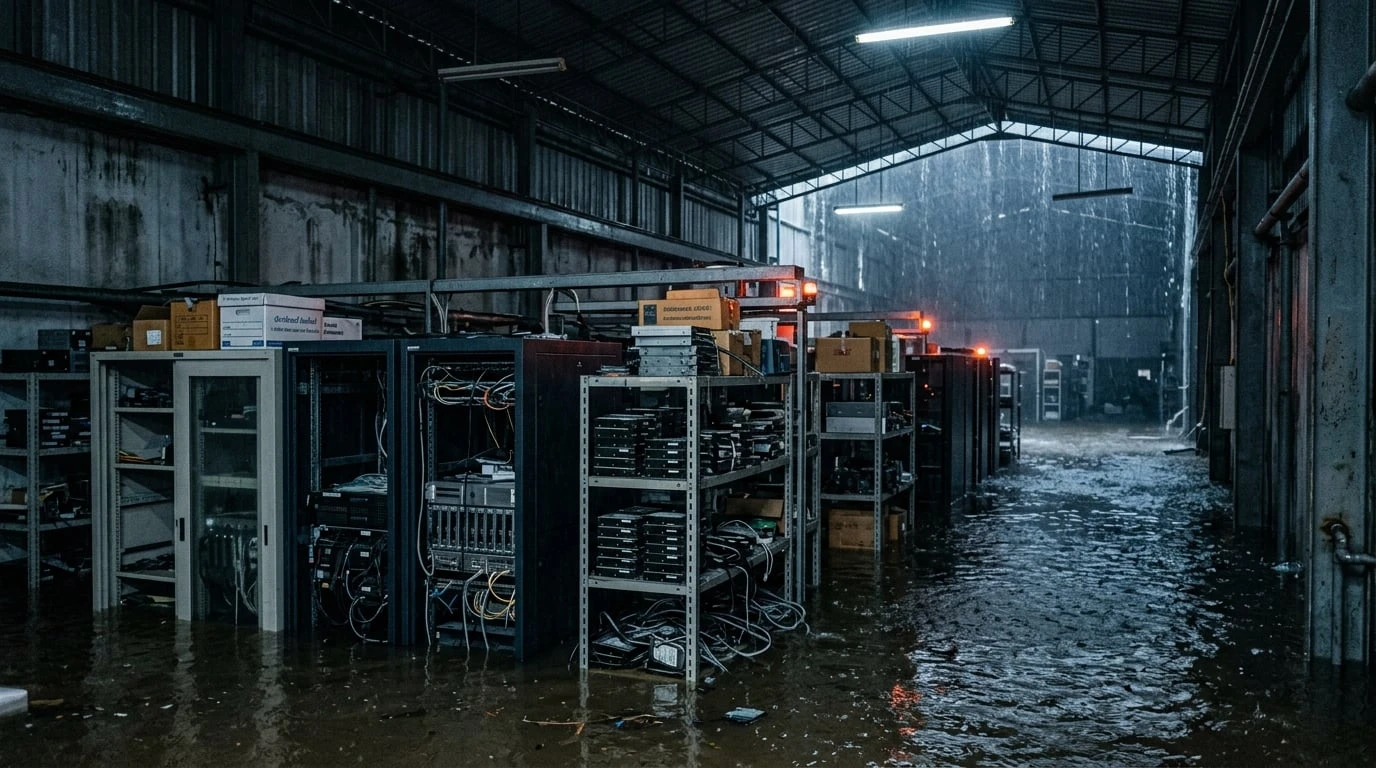
What Happened to Hard Drives
If you have tried buying a hard drive in Thailand in June or July 2026, you already know: shelves are empty, prices have skyrocketed and lead times stretch into months. Since September 2025, HDD prices have climbed 46–50% on average. Western Digital has officially stated it sold out all 2026 production by mid-February. Seagate and Toshiba are in a similar position: manufacturing capacity is locked in through 2027–2028.
This is not a temporary glitch. It is a structural market shift.
Why Drives Have Run Out
Three forces have converged — and each one alone would be serious:
1. AI Is Devouring Storage
Hyperscalers — Amazon, Microsoft, Google, Meta — have bought up nearly all HDD output for data centers that train and run AI models. Up to 89% of HDD manufacturer revenue now comes from cloud clients. The open market — retail, SMBs, system integrators — gets what is left.
2. Memory and SSD Shortage
DRAM and NAND flash manufacturers have shifted capacity toward High Bandwidth Memory (HBM) for AI servers. The result: enterprise SSD prices have surged by 250%. Companies that planned to migrate to SSDs have gone back to HDDs, adding even more pressure to an already tight market.
3. Tariffs and Logistics
New US import duties on electronics from Southeast Asia have added 10–13% to costs. Thailand is one of the world’s largest HDD manufacturing hubs, producing up to 45% of global output. Any tariff changes hit the supply chain directly. Thailand has also eliminated its THB 1,500 de minimis threshold as of January 2026 — all parcels now incur 7% VAT plus duties.
Surveillance Drives: Even Tighter
Surveillance systems rely on specialised drives — WD Purple and Seagate SkyHawk. These series are designed for 24/7 continuous recording and optimised for NVR workloads: they handle constant write loads and deliver a stable data stream without frame drops.
Since January 2026, surveillance drive prices have risen an additional 12% on top of the general increase. The average retail price for a 6–8 TB unit is $189–215. Supply is erratic: prices can shift daily and large orders take weeks to fulfil.
An extra factor is the helium shortage. Helium is essential for manufacturing high-capacity sealed drives, and demand from smart city projects outpaces production.
CCTV Cameras Have Gone Up Too
The shortage has hit more than just drives. Leading camera manufacturers adjusted prices in early 2026:
- Hikvision — prices up 8–15% across the full catalogue (IP cameras, NVRs, AI devices). The company cites a 200% rise in key component costs: memory chips, CMOS sensors and controllers.
- Dahua — increases of 3–8%, focused on storage-heavy models. Budget cameras remain stable for now.
The drivers are the same: a global DRAM deficit, semiconductor capacity diverted to AI chips, and rising costs of copper, silver and PCBs. For end users, the total cost of a surveillance system — cameras + drives + NVR — is up 15–25% compared to mid-2025.
How This Differs from the 2011 Floods
Thailand has faced an HDD supply crisis before. In 2011, catastrophic flooding destroyed roughly 30% of global HDD manufacturing capacity. Prices doubled, but the situation normalised within 12–18 months as factories were rebuilt.
This time is different. The factories are running. Capacity is intact. But the entire output has already been sold to the world’s largest corporations for years ahead. There is nothing to restore — new production lines take years to build. Western Digital received Thai Board of Investment (BOI) approval to expand, but meaningful capacity is years, not months, away.
What to Do: WLTT Recommendations
As a systems integrator in Thailand, we see the effects of this crisis every day. Here is what we advise our clients:
Plan procurement early
If you are planning to install or expand a surveillance system in the next 3–6 months, order equipment now. HDD lead times run 2–4 months, with some models taking up to six months.
Optimise storage settings
Review your recording settings: switching from continuous to motion-triggered recording can cut storage needs by 3–5x. For most sites this is the best trade-off between security and economy.
Stick with proven surveillance drives
Cutting costs with standard desktop HDDs in video systems ends up costing more: they are not designed for 24/7 loads and fail far sooner. WD Purple and Seagate SkyHawk remain the industry standard.
Consider hybrid solutions
For critical sites it makes sense to combine local storage with cloud backup. This reduces dependence on physical drive availability and adds an extra layer of data protection.
Lock in prices
If a supplier offers a fixed price on a batch — take it. Prices are being revised every 2–4 weeks in the current environment, and the trend is only upward.
Outlook
Analysts do not expect meaningful relief before the end of 2026. Manufacturers continue signing long-term contracts with cloud providers. Even if new capacity comes online in 2027, surging AI demand may absorb it entirely.
For us at WLTT this means one thing: helping clients plan projects intelligently in the new reality — factoring in shortages, higher prices and longer lead times. Planning a security system installation or upgrade? Get in touch — we will help design the optimal configuration for today’s market.