LED screens are no longer exotic — they appear in restaurants, on building facades, at music festivals, and in boardrooms. But once you open a supplier catalog, confusion sets in: P2.5, P4, P10, SMD, COB, GOB… What actually matters when choosing a screen, and what is marketing fluff?
In this article, we break down everything you need to know about LED screens: from panel manufacturing technologies to specific recommendations for typical projects in Thailand.
What Is Pixel Pitch and Why It Is the Key Spec
Pixel pitch is the distance in millimeters between the centers of adjacent LEDs. It is denoted by the letter P followed by a number: P2.5 means 2.5 mm between pixels. The smaller the number, the higher the pixel density and the sharper the image.
Pixel pitch directly determines three key parameters:
- Resolution — at the same physical size, a P1.2 screen will hold roughly 4× more pixels than a P2.5 screen.
- Minimum viewing distance — the smaller the pitch, the closer you can stand without seeing individual pixels (the "screen door effect").
- Cost — halving the pixel pitch roughly triples or quadruples the price per square meter.
Viewing Distance Formula
The industry uses a simple rule of thumb: minimum comfortable viewing distance in meters ≈ pixel pitch in mm × 1.5. Optimal distance ≈ pixel pitch × 2.5–3.
| Pixel Pitch | Min. Distance | Optimal Distance | Example Use |
|---|---|---|---|
| P1.2 | 1.8 m | 3–3.6 m | Boardroom, studio |
| P1.5 | 2.2 m | 3.7–4.5 m | Boutique, hotel lobby |
| P2.5 | 3.7 m | 6.2–7.5 m | Restaurant, bar, conference |
| P3.9 | 5.8 m | 9.7–11.7 m | Festival stage, indoor arena |
| P4.8 | 7.2 m | 12–14.4 m | Building facade, shopping mall |
| P6 | 9 m | 15–18 m | Street advertising, billboard |
| P8 | 12 m | 20–24 m | Roadside billboard |
| P10 | 15 m | 25–30 m | Highway billboard, stadium |
A common mistake is buying P1.5 for a screen that viewers see from 10 meters. The eye cannot tell the difference from P2.5, but the budget will be several times higher.
Visualization: How Different Pixel Pitches Look
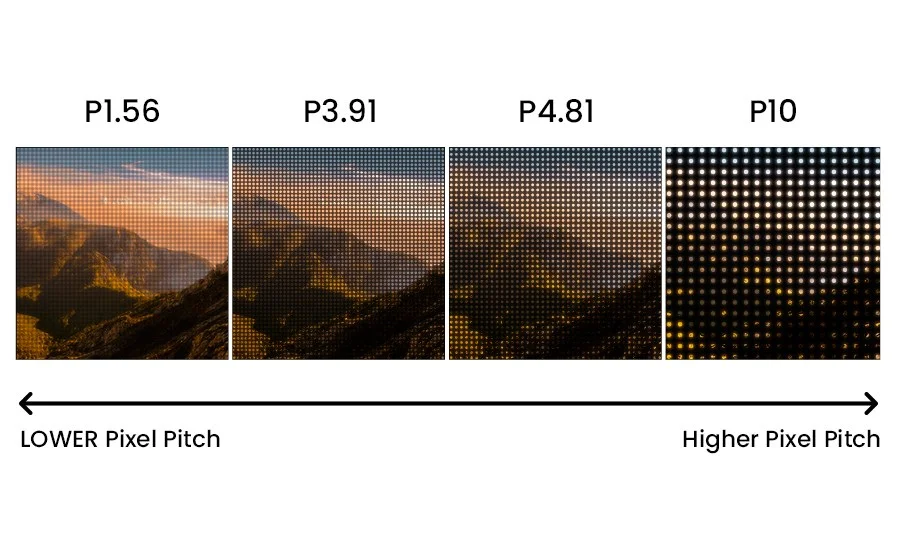
In the photo you can see: at P1.56 individual diodes are barely distinguishable, while at P10 pixels are separated by visible gaps. For a restaurant wall that guests walk right up to, this matters. For a billboard 5 meters above the ground — it does not.
LED Panel Types: SMD, COB, GOB, DIP
Beyond pixel pitch, the LED mounting technology matters. It affects brightness, reliability, repairability, and price.
DIP (Dual In-line Package)
The oldest technology: each color (R, G, B) is a separate LED in a plastic housing with two leads soldered into the PCB. DIP panels deliver very high brightness (up to 10,000 nits) and good moisture resistance, but have large pixel pitch (typically P10+) and narrow viewing angles. Today DIP is used only for large outdoor structures.
SMD (Surface-Mounted Device)
The most widely used technology. Three RGB chips are packaged in a single housing mounted on the PCB surface. SMD delivers wide viewing angles (160°–180°), supports pixel pitch from P1.2 to P10, and works for both indoor and outdoor use. Modules are easily repaired — individual pixels can be replaced.
COB (Chip-on-Board)
Premium technology: LED chips are mounted directly on the substrate and coated with a unified phosphor layer. The result is ultra-fine pixel pitch (down to P0.4), no visible "grain," the widest viewing angles (180°), superior heat dissipation, and energy efficiency. Downsides: high price and repairs only at the module level.
GOB (Glue-on-Board)
Essentially SMD coated with a protective layer of transparent epoxy glue. This layer shields diodes from impacts, moisture, and dust, turning the surface into smooth "glass." GOB is the optimal choice for high-traffic venues (restaurants, clubs) where the screen may be accidentally bumped. Cost is 20–30% higher than standard SMD, but repairability is retained.
| Parameter | DIP | SMD | COB | GOB |
|---|---|---|---|---|
| Pixel pitch | P10+ | P1.2–P10 | P0.4–P1.5 | P1.2–P4 |
| Brightness | Very high | High | Medium | High |
| Viewing angle | 120° | 160–180° | 180° | 160–180° |
| Protection (IP) | IP65+ | IP30–IP54 | IP30–IP40 | IP40–IP54 |
| Repair | Module | Pixel | Module | Pixel |
| Cost | $$ | $$$ | $$$$$ | $$$$ |
| Use case | Billboard | Universal | Studio, showroom | Restaurant, club |
IP Rating & Brightness: What Matters Outdoors
For outdoor installations, two parameters are critical:
- IP rating — minimum IP54 for sheltered mounts, IP65 for open installations (full dust and rain protection).
- Brightness — indoors 800–1,500 nits is enough, but outdoors in direct sunlight you need at least 5,000–6,000 nits.
A screen rated IP30 and 1,000 nits works great in a restaurant but will fail within a month outdoors in Thailand from moisture — and will be unreadable in daylight.
Refresh Rate & Camera Compatibility
Another parameter often overlooked: refresh rate. The human eye does not notice flicker at 60 Hz, but a camera with a short shutter speed (1/1000–1/2000 s) can capture dark bands and moiré patterns.
- 1,920 Hz — budget level, fine for outdoor signage where filming is not a concern.
- 3,840 Hz — the gold standard for restaurants, events, and any venue where guests record on their phones.
- 7,680 Hz+ — XR production, eSports arenas, film shoots.
For a restaurant, bar, or festival where every guest is a potential social media photographer, we recommend investing in 3,840 Hz panels.
Practical Scenarios: What to Choose
🍽 Restaurant or Bar
Typical task: LED wall behind the bar counter or in the VIP area. Guests are 2–4 meters away, filming on phones. Ambient lighting is dim.
- Pixel pitch: P1.5–P2.5 (depends on distance to nearest table)
- Technology: GOB (impact and moisture protection) or indoor SMD
- Brightness: 800–1,500 nits (more would blind guests)
- Refresh rate: 3,840 Hz (for flicker-free photos and videos)
- Mounting: wall-mount cabinet type, from 45 mm depth
🎵 Music Festival or Stage
Open-air stage: viewers are 5–50 meters away. Screen is in sunlight or stage lighting. Setup and teardown within hours.
- Pixel pitch: P3.9–P4.8 (front rows from 5–6 m, main audience from 10+)
- Technology: outdoor SMD with IP65
- Brightness: 5,000–6,000 nits (daytime events), 3,000–4,000 nits (evening)
- Refresh rate: 3,840 Hz (livestreaming and filming guaranteed)
- Design: quick-release modules 500×500 mm or 500×1,000 mm with latches
🏙 Outdoor Billboard
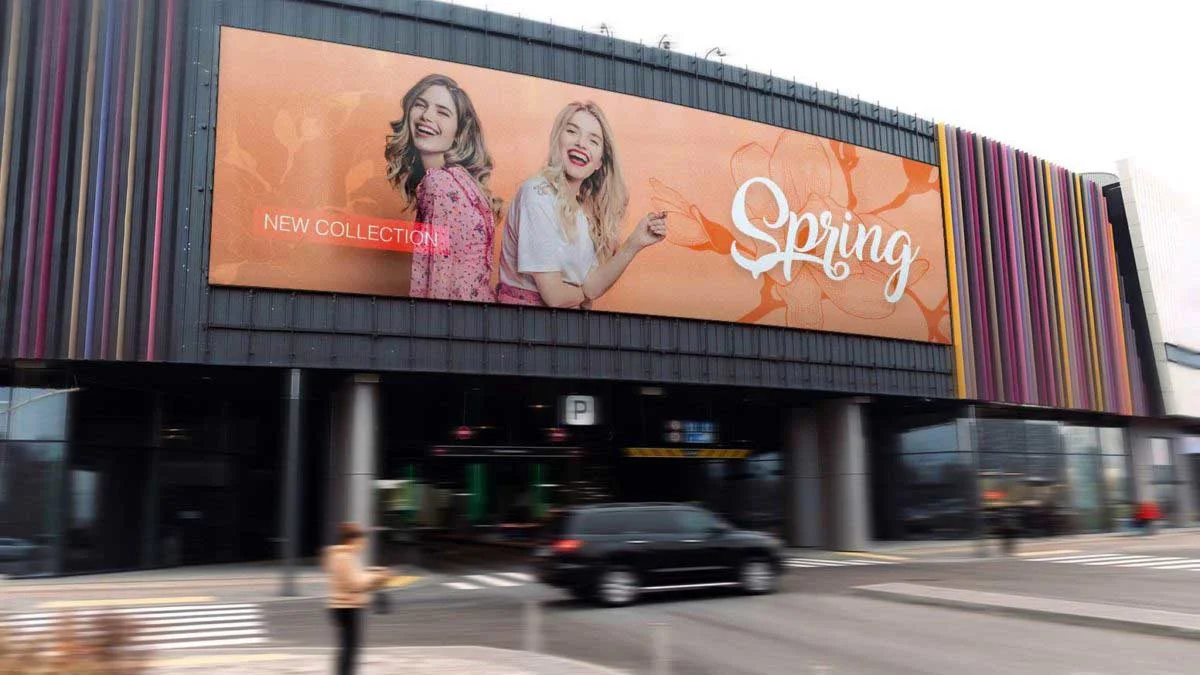
Advertising board on a facade or roadside structure. Nearest viewer is 10+ meters away, most are 20+. Runs 24/7.
- Pixel pitch: P6–P10 (roadside) or P4–P6 (shopping mall facades)
- Technology: outdoor SMD or DIP (for maximum brightness)
- Brightness: 6,000–10,000 nits
- IP rating: IP65 mandatory (Thailand has a monsoon season!)
- Extras: ambient light sensor for auto-brightness, cabinet ventilation
Summary Table: Pixel Pitch by Scenario
| Scenario | Pixel Pitch | Technology | Brightness | IP |
|---|---|---|---|---|
| Boardroom / studio | P0.9–P1.5 | COB / SMD | 600–1,000 nits | IP30 |
| Restaurant / bar | P1.5–P2.5 | GOB / SMD | 800–1,500 nits | IP30–IP40 |
| Hotel lobby / retail | P2.0–P3.0 | SMD / GOB | 1,000–2,000 nits | IP30 |
| Conference / stage | P2.5–P3.9 | SMD | 2,000–4,000 nits | IP30–IP54 |
| Festival / open-air | P3.9–P4.8 | Outdoor SMD | 5,000–6,000 nits | IP65 |
| Facade / mall | P4–P6 | Outdoor SMD | 5,000–7,000 nits | IP65 |
| Billboard / highway | P6–P10 | SMD / DIP | 6,000–10,000 nits | IP65 |
Other Important Considerations
- Content management — you need a media player (Novastar, Colorlight) or cloud CMS. For restaurants, a simple CMS with content scheduling works best.
- Calibration — after installation, panels are calibrated for brightness and color. Without calibration, you can see "patches" at module seams.
- Power consumption — typically 300–600 W/m² at full brightness. A 3×2 m wall draws up to 3.6 kW — factor this into electrical planning.
- Ventilation — the back of the screen must be ventilated. For built-in installations (wall niche), plan for exhaust.
- Service access — front (remove module from the front) or rear (access from behind). For a restaurant wall with no gap behind it, front-service panels are required.
What WLTT Does
WLTT designs and installs LED installations for restaurants, bars, events, and outdoor advertising across Thailand. We select the optimal pixel pitch and technology for each specific project, handle the electrical planning, prepare mounting structures, and configure the content management system.
If you are planning an LED screen for your business — contact us for a free estimate. We will help you choose equipment that solves your actual problem, not just "looks cool in the catalog."