There is a paradox in Southeast Asian restaurant marketing. Venues invest heavily in acquiring guests — advertising, promotions, influencer collaborations — while doing almost nothing with the people who already came and left happy. Roughly one in four venues has a loyalty program. Only a handful of them actually work.
The reason is usually the same: the barrier to entry is too high. For the guest — download an app, register, remember a password, carry a card. For the venue — maintain a system, train staff, award points manually. In the end the loyalty program exists on paper, and neither side extracts any real value from it.
This is the second article in our series on the ResoGuest platform. In the first, we explained why a POS sees a transaction but not a guest. Now — a specific module: loyalty.
A card that is always with you
The ResoGuest loyalty module is built around a different principle: loyalty must be zero-friction.
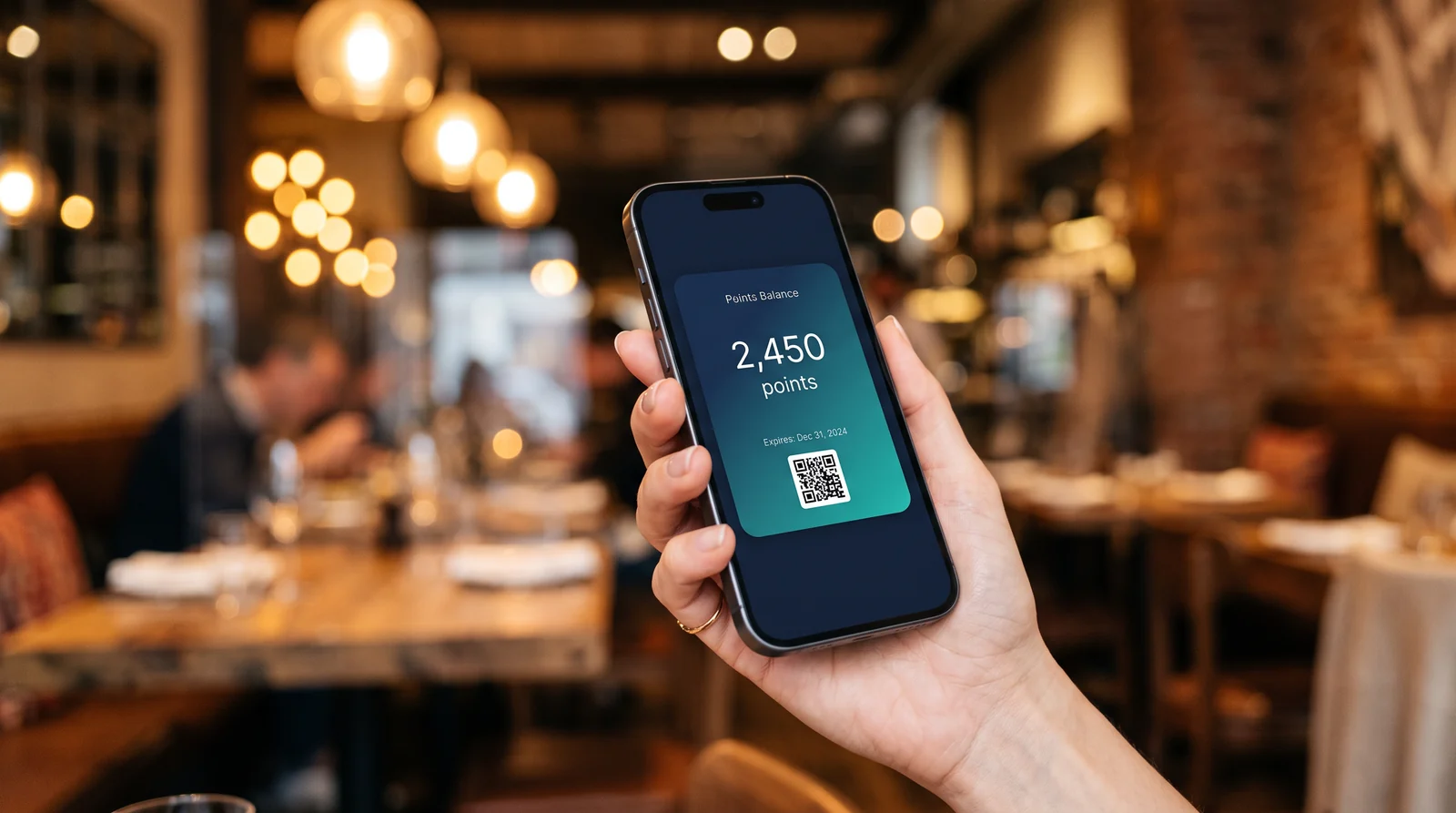
The guest receives a link — via a QR code on the table, a message in Telegram or WhatsApp, or a page shown after booking — and with a single tap adds a digital card to Apple Wallet or Google Wallet. No app. No password registration. The card appears next to bank cards and boarding passes — right where a person naturally looks a second before paying.
From that moment the card lives on its own. On every visit, points are awarded automatically — data flows in from the integration with the Syrve POS. The balance on the card updates in real time. The guest sees an up-to-date balance without a single extra action on their part.
How earning and redemption work
The accrual mechanics are configured per venue. The basic scheme: a set percentage of the check total is converted into points. Add-ons — multipliers for specific dishes, double points on chosen days, a first-visit bonus.
Guest tiers are another tool that works as a self-reinforcing mechanic. The more often a guest comes and the more they spend, the higher their tier. The tier determines the multiplier size: a Gold-tier guest earns points faster than a new guest. This creates an organic sense of progress and gives a concrete reason to return.
Staff need no extra apps to redeem points. Through the ResoGuest dashboard, a waiter sees the guest’s balance and can apply a redemption right at checkout. Or the guest does it themselves through a widget — enters a phone number, sees the balance, confirms the use.
Stamp cards are a separate format for venues where simplicity fits: “buy 9 coffees — get the 10th free.” The same mechanic through a digital card in Wallet: each visit adds a stamp, the final stamp unlocks the reward. No paper, no “the card is at home.”
What it gives the owner
A loyalty program is not just a nice bonus for guests. It is a source of data about audience behavior that starts working from a member’s very first visit.
The dashboard shows the distribution of guests across tiers, average check by segment, and the activity dynamics of program members. When part of the Silver-tier guests haven’t come in three weeks — that is a signal for a win-back campaign. When program members spend 30% more on average than non-members — that is an argument for calculating ROI.
Loyalty data in ResoGuest does not exist separately from the rest of the guest’s information. The points balance is part of a single profile, alongside booking history, preferences, and reviews. This makes it possible to build personalized offers rather than identical blasts to the entire base.
A multi-card for restaurant groups
For venues operating under one brand or within a group, ResoGuest supports a group loyalty card. The guest gets a single card that works across all venues in the group: points are earned and spent at any of them.
This is especially relevant for restaurant groups in tourist locations: a guest who discovers the brand at one restaurant naturally moves to another — and the group keeps them in its orbit.
Why a digital Wallet works better than an app
Restaurant apps are a dead end for most mid-scale venues. Development costs anywhere from a few thousand to tens of thousands of dollars. Install conversion rarely exceeds 15–20% of the audience. Then the app has to be maintained, updated for new iOS and Android versions, and kept from being deleted off phones.
Apple Wallet and Google Wallet are installed on the phone by default. Adding a card takes three seconds. The card is not deleted, requires no updates, and works offline.
This fundamentally changes the economics of loyalty. Instead of investing in development — configuring a card in the ResoGuest interface. Instead of fighting for an app install — a simple link or QR code. Instead of an app’s activity gradually fading — a card visible every time the guest opens their wallet.
«A loyalty program has to work. Not as a pretty idea in a marketing deck, but as a real tool that increases visit frequency and average check. For that, it must be simple — for the guest and for the venue’s team.»
In the next articles of the series we will break down the platform’s remaining modules — reservations, reviews and reputation, and automated guest communications.