When an entrepreneur opens a restaurant or café in Thailand, most attention goes to the concept, menu, interior design and marketing. Electrical work seems "obvious" — sockets, lights, cables. But mistakes in the power supply lead to the most expensive and dangerous consequences: from burnt-out equipment worth hundreds of thousands of baht to fires and fines from regulators.
In this article we explain why a professional electrical design is not an "extra expense" but an investment that pays for itself in the first months of operation.
How restaurant electrics differ from a residential building
In a typical apartment or house the total load seldom exceeds 10–15 kW. In a mid-size restaurant (200–500 m²) we are talking about 50–150 kW or more. Commercial combi-ovens, electric fryers, walk-in cold rooms and tunnel dishwashers each draw 5 to 30 kW.
Add HVAC systems (especially important in Thailand's tropical climate), lighting, POS terminals, server equipment, audio systems and ventilation. Everything must run simultaneously without voltage drops or overloads.
- Three-phase supply (380 V) for heavy kitchen equipment.
- Separate breaker groups for the kitchen, bar, dining area, back-of-house and HVAC.
- Differential protection (RCD/RCBO) on every critical circuit — for staff safety.
- UPS (uninterruptible power supply) for POS stations and servers.
- Emergency lighting at evacuation exits per fire-safety codes.
Common mistakes: when cutting corners turns into losses
At WLTT we regularly visit sites where the electrical work was done "by eye" — without a design or load calculation. Here is what we see most often:
1. Undersized cable
The contractor runs 2.5 mm² cable to a three-phase oven that needs 6 mm² or more. In the first months the cable overheats, insulation degrades, and within half a year there is a short circuit. Rewiring an operating restaurant costs 3–5× more than doing it right during the fit-out.
2. No breaker selectivity
All circuits are connected to a single breaker. When it trips the entire restaurant goes dark — kitchen, dining room, POS, cold rooms. Losing product in a walk-in cold room overnight can cost 50,000–100,000 THB or more.
3. Missing or token earthing
Thailand's tropical climate means high thunderstorm activity. Without proper earthing and lightning protection, a single storm can destroy POS terminals, NVRs, air-conditioning units and routers — tens of thousands of baht in damage plus business downtime.
4. HVAC loads not accounted for
A restaurant in Phuket or Pattaya may operate year-round at +30…+35 °C. The HVAC system is one of the hungriest consumers. If it was not included in the calculation, the distribution board overloads in the first hot month.
«We have seen restaurants where staff switched off the kitchen air-con to avoid tripping the breaker when starting the dishwasher. That is not normal — that is the result of having no electrical design.»
What a professional electrical design includes
A design is not a "sketch on a napkin". It is a document that tells electricians exactly what to install where, and lets the client verify the result.
- Load calculation — total power of every piece of equipment with a simultaneity factor.
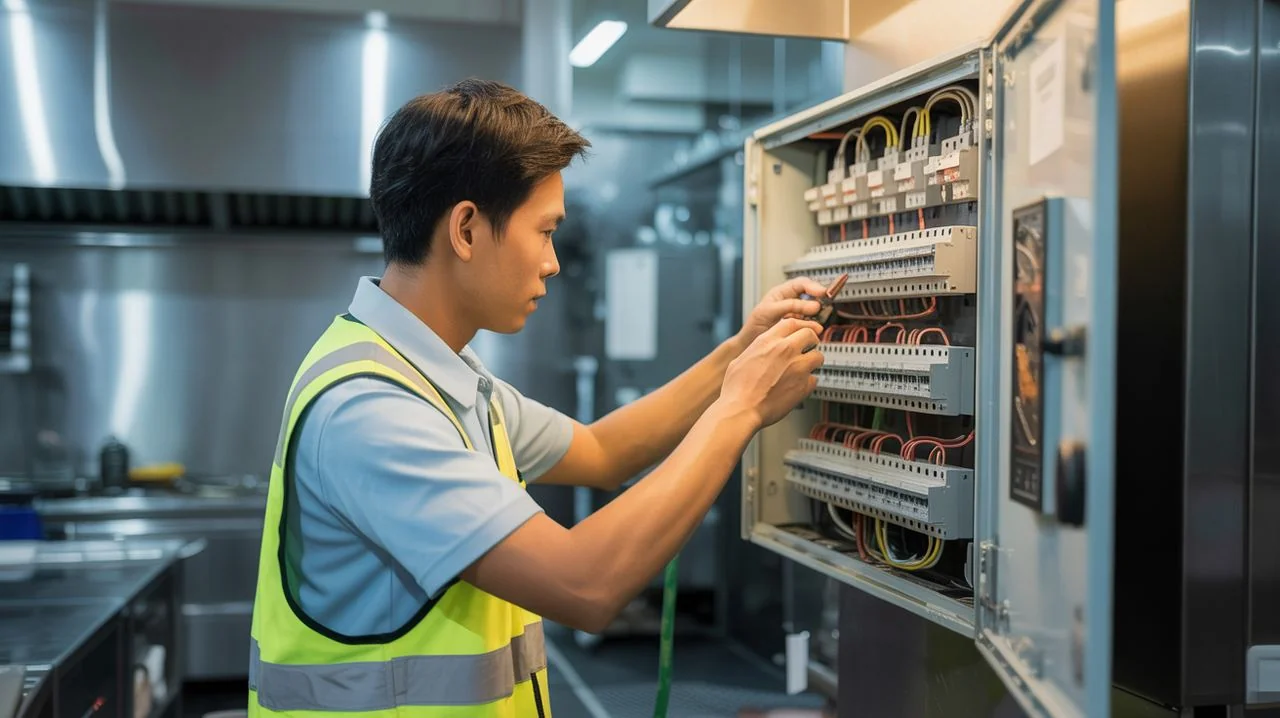
- Single-line diagram — breaker ratings, RCDs and grouping by zone.
- Cable routing plan — cable runs with cross-sections and types.
- Equipment specification — brands of breakers, cables, boards, sockets, luminaires.
- Earthing and lightning-protection scheme.
- Emergency lighting and fire-alarm power scheme.
- Coordination with the low-voltage project (CCTV, WiFi, POS) — so that power points end up where they are needed.
Thai standards: TIS, PEA and MEA
In Thailand electricity supply is regulated by the Provincial Electricity Authority (PEA) for regions and the Metropolitan Electricity Authority (MEA) for Bangkok. For commercial premises (and a restaurant is a commercial premises) the requirements include:
- Use of certified equipment (TIS — Thai Industrial Standard).
- Emergency lighting per fire-safety regulations.
- Earth-leakage protection (ELCB) on circuits accessible to touch.
Non-compliance is not just about fines. An insurance company may refuse a payout in the event of a fire if the electrical installation does not meet the standards.
Electrical and low-voltage: why they must be designed together
A common problem: the electrician finishes, then the CCTV crew arrives, then the network team, then the audio contractor. Everyone runs their own cables, crossing each other's trays. The result is chaos above the ceiling tiles, interference and impossible maintenance.
WLTT designs electrical and low-voltage systems as a single package. This means:
- Power outlets for cameras, WiFi access points and POS terminals are included in the electrical design from day one.
- Cable trays are routed in parallel, maintaining the required separation between power and data cables.
- The UPS for the server rack and POS zone gets a dedicated circuit.
- No need to chase walls or redo ceilings after the main fit-out.
How much does an electrical design for a restaurant cost?
The cost depends on the floor area, number of appliances and complexity of the site. For a 200–500 m² restaurant it is typically a small fraction of the total fit-out budget — yet this fraction determines whether the restaurant runs smoothly or the owner calls an electrician every month to fix emergencies.
The final estimate covers design, materials (boards, breakers, cables, sockets, luminaires), installation and commissioning. WLTT provides a detailed specification before work starts — no "surprises" along the way.
Summary: 7 reasons to commission an electrical design before the fit-out
- Safety: proper protection against overloads, leakage currents and lightning.
- Reliability: the restaurant operates without tripped breakers or voltage drops.
- Savings: no need to rewire an operating venue.
- Compliance: a design to PEA/MEA standards is the basis for insurance and licences.
- Coordination: electrical, CCTV, WiFi and POS are designed as one.
- Transparency: the client receives a full documentation package and knows what they are paying for.
- Scalability: if you add equipment in a year the distribution board is ready to expand.
If you are opening a restaurant, café or bar in Thailand — start with an electrical design. Send us a request and we will prepare a commercial offer with a load calculation for your equipment.