When a client sees the cost of an AUDAC audio system in a commercial estimate, the first question is predictable: "Why so expensive? Can't we just install regular speakers and an amplifier?". You can. But after six months of operation, the difference becomes obvious — in reliability, manageability, scalability and total cost of ownership. In this article, we break down what exactly stands behind AUDAC's price tag and why for restaurants, hotels and sports complexes in Thailand, it's an investment, not an expense.
We use AUDAC on every commercial project — from intimate restaurants in Phuket to 5,000 m² sports complexes. And every time, professional audio proves its worth.
AUDAC — who they are and where they come from
AUDAC is a Belgian manufacturer of professional audio equipment, founded in 2003. The company specialises exclusively in commercial and installation audio — this is not a side project of a consumer brand, but a focused expertise. All products are designed and tested at their headquarters in Belgium.
The product range covers everything needed for a complete audio system: from wall-mounted control panels and microphones to matrix processors, amplifiers and speaker systems. Crucially, all components are designed to work together — it's not a collection of disparate devices, but a unified ecosystem.
Dante/AES67 architecture — audio over the network
AUDAC's key architectural advantage is its support for Dante digital audio networking (and the open AES67 standard). Instead of kilometres of analogue audio cables from each source to each amplifier, sound travels over a standard Ethernet network. The same switch, the same Cat6 cable — carrying data, PoE power and audio signal simultaneously.
«Dante is not just a way to transmit sound. It's an architectural approach where any source can be routed to any zone through a standard IP network.»
What this means in practice:
- No separate audio cables between zones — everything runs through structured cabling (SCS).
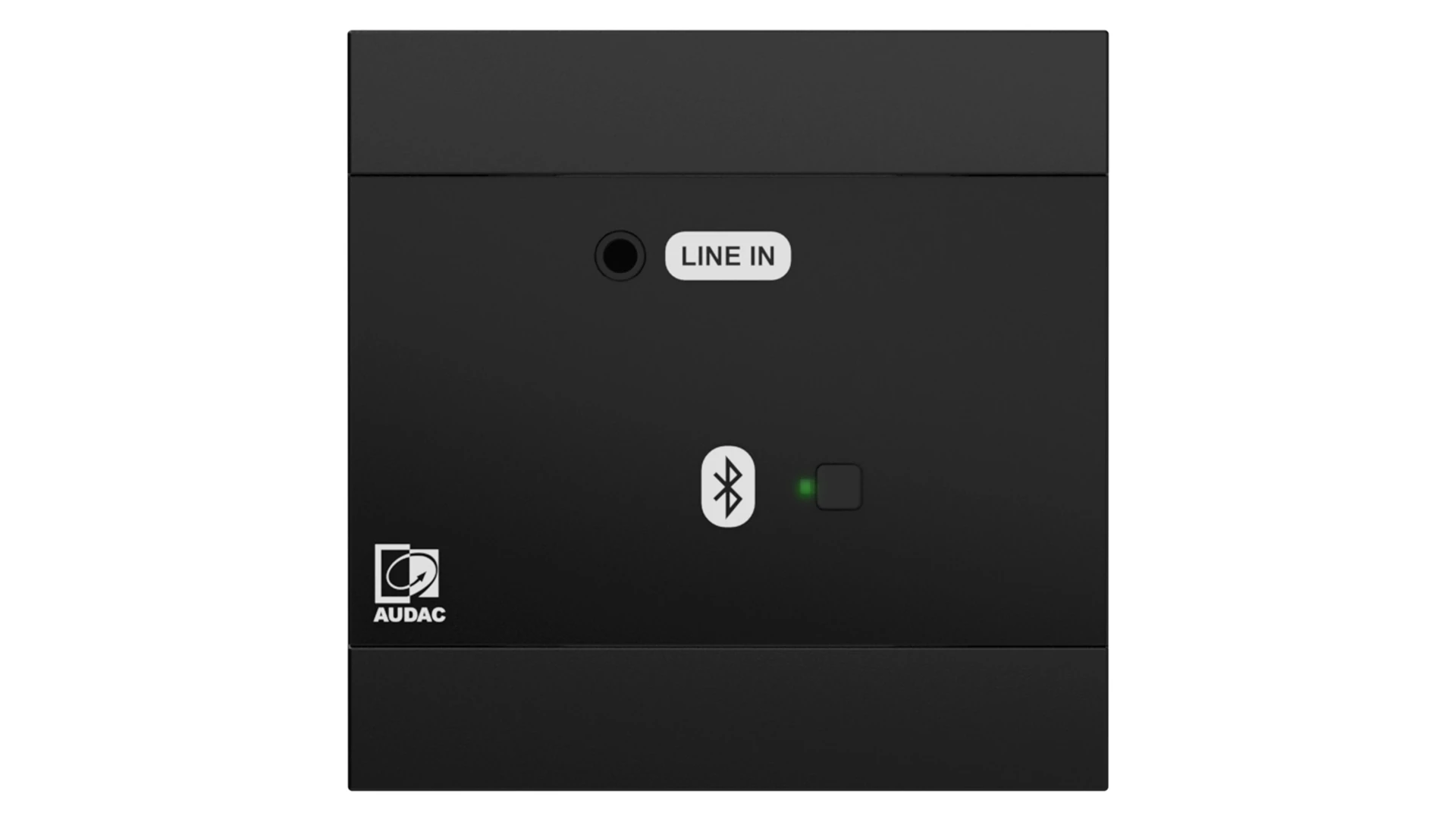
- Any source (microphone, Bluetooth, Line In) from any panel can be routed to any zone — via Dante Controller or AUDAC Touch 2.
- Latency under 1 ms — imperceptible to the human ear, critically important for announcements and live sound.
- Scaling — adding a zone = connecting a panel to the network. No re-wiring amplifiers or running new cables.
- Compatibility with other manufacturers' equipment via AES67 (Biamp, Shure, Sennheiser, QSC).
PoE power: one cable — sound, control, and power
All AUDAC NWP series wall panels (NWP222, NWP300, NWP320, NWP400) and the NCP105 controller are powered via PoE (802.3af). Power consumption is just 5–10 W. This means each panel needs only a single Ethernet cable, which simultaneously provides:
- Power supply (PoE 802.3af)
- Dante/AES67 audio signal (4 channels)
- Control via AUDAC Touch 2
- Bluetooth receiver (built into the panel)
For comparison: a traditional analogue system requires at least 3 cables to each control point — 220V power, audio signal and control cable. With 10 zones, that's 30 cables instead of 10. The difference in installation and cabling costs is substantial.
AUDAC Touch 2 control: flexibility without programming
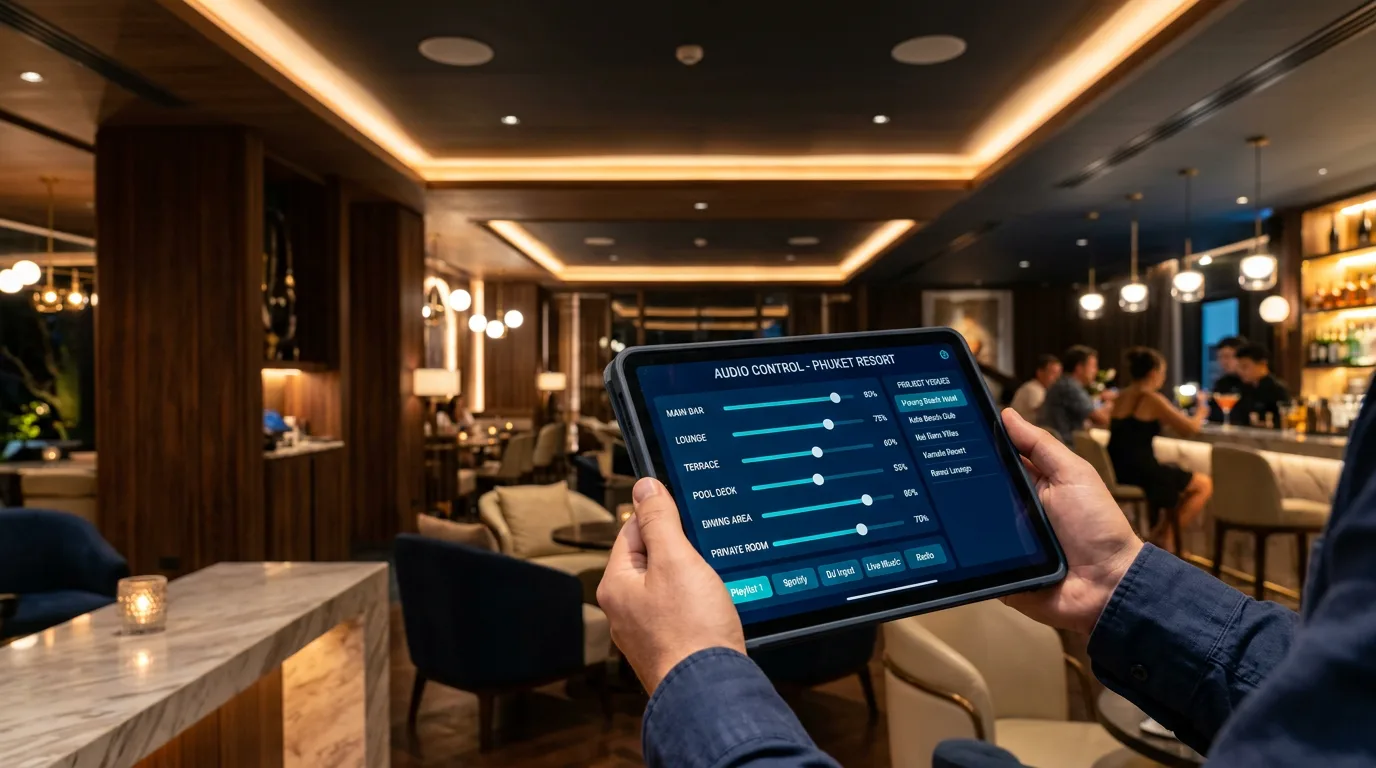
AUDAC Touch 2 is an iOS app (iPad) that turns a tablet into a full audio system control desk. A restaurant administrator or manager can:
- Adjust volume in each zone independently.
- Switch audio sources: Bluetooth from the manager's phone, Line In from a DJ desk, microphone for announcements.
- Create automation scenarios: morning ambience, evening mode, live music, special event.
- Set schedules: auto-on at 10:00, lower volume after 22:00, off at midnight.
- Monitor VU meters, device connection status, amplifier temperatures.
The interface is visual, intuitive, and requires no technical expertise. This is critically important for commercial venues where the audio system is managed by restaurant staff or hotel reception — not engineers.
Modularity and scalability
One of AUDAC's key advantages is its modular architecture. The system grows with the business:
- Opened a summer terrace? Add an NWP320 panel and a pair of speakers — they connect to the existing network without replacing the processor.
- Need paging for announcements? Connect an NPM200 console — it runs on Dante, no additional cables.
- Expanding the complex? The LUNA-U matrix processor scales to 64×64 channels through software licensing.
- The LUNA-F matrix processor supports expansion up to 64×64 Dante/AES67 channels.
This is fundamentally different from budget systems, where adding a zone often means replacing the entire equipment.
Warranty and industrial reliability
AUDAC provides a 1-year warranty across its entire product line — from amplifiers and processors to passive speaker systems.
Behind this warranty stands real engineering reliability:
- SMQ/PMQ and SMA series amplifiers use Class D technology — high efficiency, minimal heat, 24/7 operation without overheating.
- NWP wall panels are rated for tens of thousands of button presses and knob turns.
- All components undergo climate testing — critical for Thailand's hot and humid conditions.
- Quality as a fundamental business principle: every product is designed to exceed user expectations.
For comparison: typical budget brand lifespan is 0.5–1 year. Replacing an amplifier in a restaurant after 18 months means not just the cost of a new unit, but downtime, dismounting, reconfiguration. With AUDAC, this scenario is virtually eliminated.
Real-world case: LUDUS Sports Complex
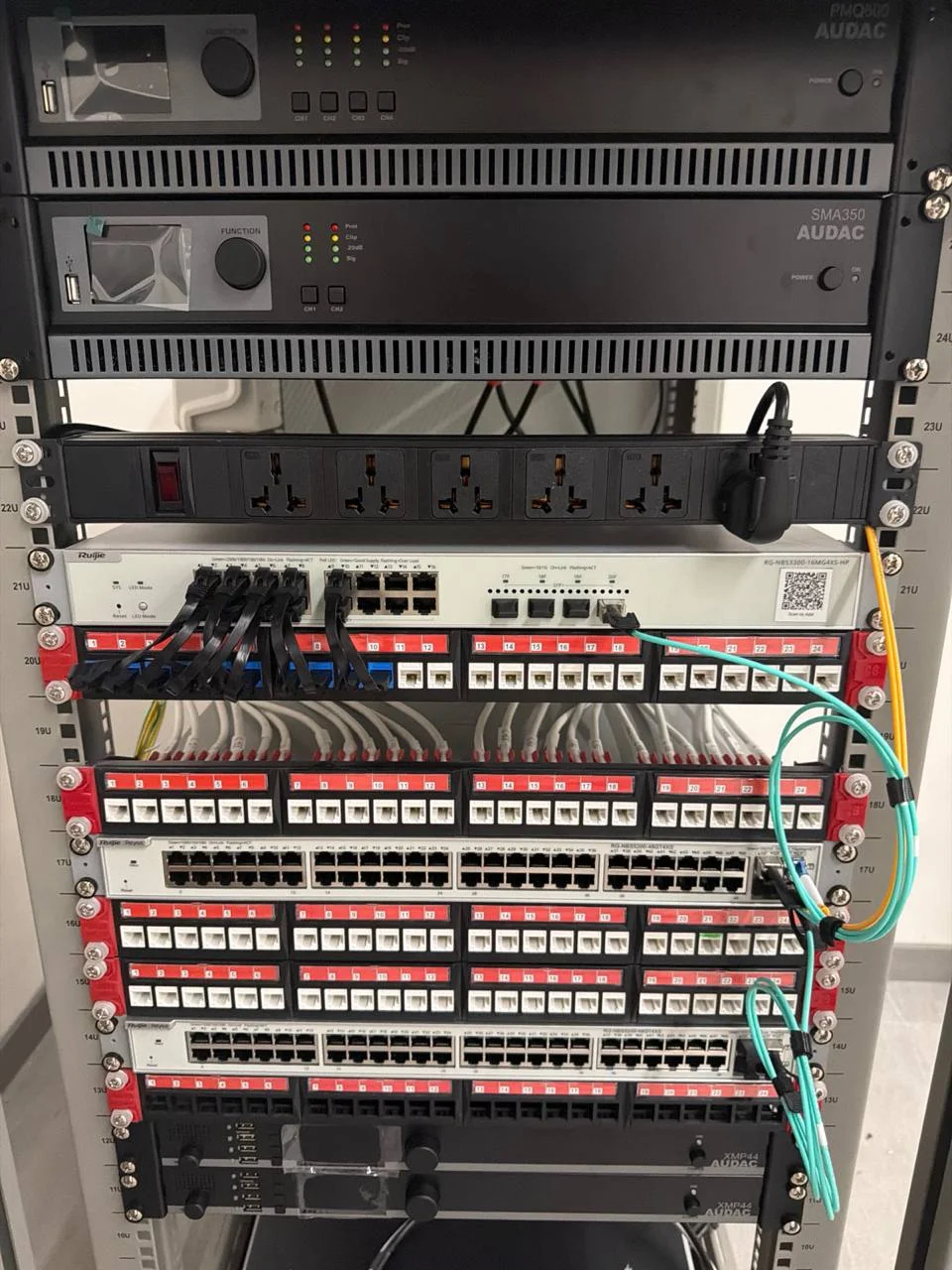
LUDUS Sports Complex in Chalong (Phuket) is a clear example of how AUDAC works in a real 5,000 m² facility.
Audio system composition
- AUDAC LUNA-F matrix processor — the central "brain" of the system, routing audio streams between zones.
- AUDAC XMP44 — a professional modular audio system with four slots for SourceCon interface cards: FM/DAB+ tuners, internet radio, voice file interfaces, and the NMP40 module for streaming from Spotify Connect and Soundtrack Your Brand (a B2B music delivery platform with commercial licensing).
- AUDAC PMQ240, PMQ480, PMQ600 and SMA350 amplifiers — powerful Class D amplifiers for different areas of the complex.
- Wall panels NWP222/B, NWP300/B, NCP105/B, NWP320/B — audio control in every zone: gym floors, conference room, spa, retail shop, reception.
- All panels are PoE-powered (802.3af), audio signal transmitted via Dante over the same Cat6 network.
What this gives LUDUS
- Independent audio control in each zone — energetic music in the gym, relaxation in the spa, silence or presentations in the conference room.
- Reception staff control the entire system via iPad with AUDAC Touch 2 — no need to call an engineer.
- Expandability: when LUDUS opens new zones, simply add panels to the network — everything works.
- Unified Cat6 cabling infrastructure for WiFi, CCTV, audio and PoE power — minimum cables, maximum order in the server rack.
Comparison with budget alternatives
Let's consider what a commercial venue owner gets (and loses) by choosing a budget audio system over AUDAC:
Cabling infrastructure
- AUDAC (Dante + PoE): 1 Cat6 cable per panel. 10 zones = 10 cables.
- Budget analogue system: 3–4 cables per zone (220V, audio, control). 10 zones = 30–40 cables.
- Savings on cabling and installation: 40–60% when using AUDAC.
Management
- AUDAC: centralised via Touch 2, schedule automation, monitoring.
- Budget: manual knobs on the wall, no remote access, no automation.
Scaling
- AUDAC: add a zone = panel + cable. No processor or amplifier replacement.
- Budget: add a zone = often replacing the amplifier/mixer with a more powerful one + new wiring.
Total cost of ownership (TCO)
When calculated over several years, a budget system often ends up costing more: replacing failed components, re-installation, business downtime, inability to expand. AUDAC costs more upfront but is cheaper to operate.
Which venues benefit most from AUDAC
- Restaurants and bars — multi-zone audio with guest Bluetooth, scenario automation, 24/7 background music.
- Hotels and spas — independent zones (lobby, pool, restaurant, rooms), quiet PoE installation, building management integration.
- Sports complexes and fitness centres — powerful gym sound, paging announcements, reception control.
- Offices and coworking spaces — background sound, announcements, meeting room zoning.
- Shopping centres and retail — background music, zone marketing, advertising system integration.
The common denominator: venues where audio runs constantly, there are multiple zones, and a reliable system is needed that regular staff can operate.
Summary: why we choose AUDAC for our projects
Over 8 years working in Thailand, we have installed AUDAC at dozens of commercial venues — from small restaurants to large sports complexes. Here's why:
- Dante/AES67 — digital audio over existing network, no analogue cables.
- PoE-powered panels — one cable handles everything.
- 1-year warranty and 24/7 reliability — minimal warranty claims.
- AUDAC Touch 2 — control designed for people, not engineers.
- Modularity — the system grows with the client's business.
- Total cost of ownership — lower than budget alternatives in the long run.
Want a professional audio system for your venue?
We design and install AUDAC audio systems for restaurants, hotels, sports complexes and commercial venues across Thailand. Free consultation, acoustic-aware design, turnkey installation and system configuration.