Cable infrastructure is the foundation of every network. WiFi access points, IP cameras, POS terminals, telephony, access control — all run on twisted-pair cable. But between "cable is installed" and "the network will work reliably for the next 15 years" there is an enormous difference. And that difference is determined not just by the cable category, but by the conductor material.
In this article we break down the three main cable types — CAT5e, CAT6 and CAT6A — explain why PoE-powered devices require solid copper (BC — Bare Copper), and show the real consequences of cutting costs with copper-clad aluminum (CCA).
CAT5e, CAT6, CAT6A — what is the difference
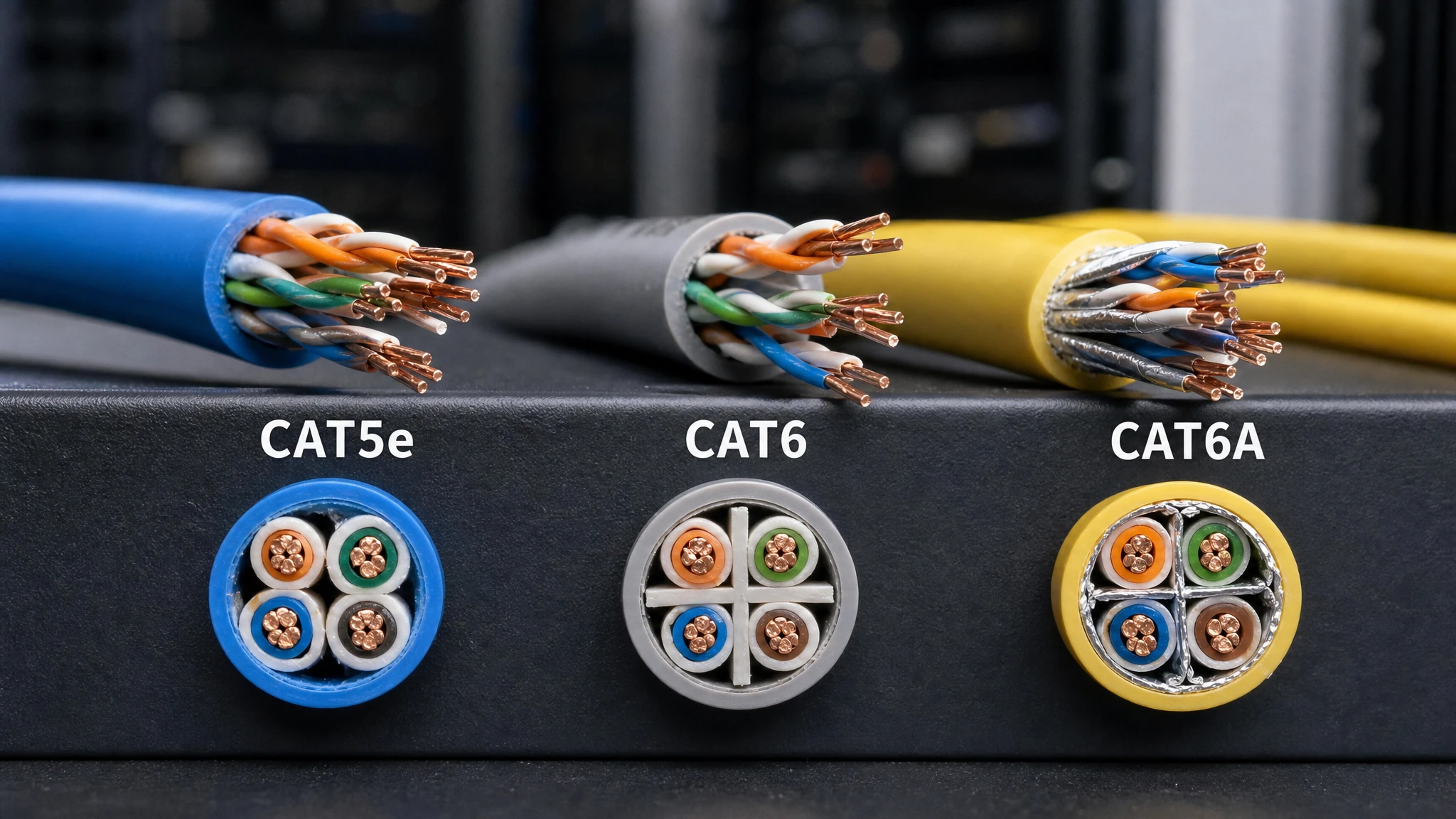
All three categories are twisted-pair copper cables designed for data and power transmission. The difference lies in bandwidth, maximum segment length at high speeds, and construction.
CAT5e (Category 5 enhanced)
- Bandwidth: 100 MHz.
- Speed: up to 1 Gbps at distances up to 100 m.
- Construction: 4 twisted pairs, no separator between pairs.
- Use cases: office networks, VoIP telephony, basic CCTV, access control systems.
- Status: outdated for new installations but still found in existing setups.
CAT6 (Category 6)
- Bandwidth: 250 MHz.
- Speed: 1 Gbps at 100 m; 10 Gbps on short segments up to 55 m.
- Construction: tighter twist, plastic spline separator between pairs.
- Use cases: structured cabling in hotels, restaurants, offices. The go-to standard for new builds.
- Status: best price-to-performance ratio for most projects.
CAT6A (Category 6 Augmented)
- Bandwidth: 500 MHz.
- Speed: 10 Gbps over the full 100 m.
- Construction: enhanced shielding (F/UTP or U/FTP), larger cable diameter, stiffer jacket.
- Use cases: server rooms, backbone links, high-density PoE deployments (Wi-Fi 6E/7, multi-sensor IP cameras).
- Status: the standard for installations designed to last 10+ years.
Cable comparison table
Below are the key specifications we consider when designing cabling systems for our clients.
- Bandwidth — CAT5e: 100 MHz · CAT6: 250 MHz · CAT6A: 500 MHz
- Max speed — CAT5e: 1 Gbps · CAT6: 10 Gbps (up to 55 m) · CAT6A: 10 Gbps (up to 100 m)
- PoE++ support (802.3bt, 90 W) — CAT5e: limited · CAT6: yes · CAT6A: yes (optimal)
- Shielding — CAT5e: UTP · CAT6: UTP/F/UTP · CAT6A: F/UTP or U/FTP
- Outer diameter — CAT5e: ~5.5 mm · CAT6: ~6.0 mm · CAT6A: ~7.5 mm
- Service life (proper installation) — CAT5e: 10–15 years · CAT6: 15–20 years · CAT6A: 20–25 years
- Price (BC, solid copper) — CAT5e: $ · CAT6: $$ · CAT6A: $$$
BC vs CCA: why conductor material matters more than category
BC (Bare Copper) is cable with solid copper conductors. CCA (Copper Clad Aluminum) is an aluminum conductor coated with a thin copper layer. They look identical on the outside: same jacket, same markings. But the difference is critical.
Why PoE demands solid copper
Power over Ethernet (PoE) transmits electrical power over the same conductors as data. Modern PoE++ (IEEE 802.3bt) delivers up to 90 W per port. That is a serious load and the conductor must handle it.
Aluminum has roughly 55% higher electrical resistance than copper. In practice this means:
- Greater voltage drop on long runs. The PoE device (camera, access point) does not receive the rated power — random reboots, dropouts and instability follow.
- Cable overheating. High resistance = more energy dissipated as heat. In cable bundles inside closed trays or walls, this is a fire risk.
- Aluminum melting point is ~660 °C vs ~1 085 °C for copper. Under thermal stress CCA fails much sooner.
- Aluminum oxidation. At contact points (RJ45 connectors, patch panels) aluminum oxidizes, contacts degrade. Over time this causes link loss and false alarms in security systems.
- Brittleness. Aluminum breaks under bending far more easily than copper. During installation in walls, trays and above ceilings, bends are unavoidable.
CCA violates industry standards
Using CCA cable for structured cabling is prohibited by TIA-568, UL 444, ISO/IEC 11801 and the NEC (National Electrical Code). Cable with aluminum conductors cannot obtain CM/CMR/CMP certification for in-building installation. If CCA cable is labelled "CAT6" or "CMR" — it is counterfeit.
Comparison table: BC vs CCA
- Conductor material — BC: solid copper (99.9%) · CCA: aluminum with copper coating
- Resistance (Ω/100 m) — BC: ~9.38 · CCA: ~14.5 (+55%)
- PoE/PoE+ support — BC: full · CCA: limited (losses, overheating)
- PoE++ support (90 W) — BC: yes · CCA: no (dangerous)
- TIA/ISO compliance — BC: yes · CCA: no
- CM/CMR/CMP certification — BC: yes · CCA: impossible
- Oxidation resistance — BC: high · CCA: low (contact degradation)
- Mechanical strength — BC: high · CCA: brittle under bending
- Melting point — BC: ~1 085 °C · CCA: ~660 °C
- Fire risk under PoE — BC: minimal · CCA: high
- Cost — BC: ×1.5–2.0 more expensive · CCA: cheaper
- Service life — BC: 15–25 years · CCA: 3–5 years (degradation)
Solid copper cable costs 1.5–2× more than CCA. But within the overall project budget the cable price difference accounts for only 5–8% of the total low-voltage spend. The cost of consequences — demolition, re-renovation, business downtime — is tens of times higher.
Real-world scenario: when "savings" cost three times more
We regularly encounter the aftermath of CCA cable on sites installed by other contractors. Here is a typical scenario that repeats itself with alarming regularity.
A restaurant owner in Phuket orders low-voltage installation: 16 Hikvision PoE IP cameras, 6 WiFi access points, a POS terminal and kitchen printers. The contractor, looking to reduce the quote and win the tender, buys CCA cable instead of copper. The saving — roughly 30 000–40 000 THB on cable (for 2 000–2 500 metres of runs).
What happens next
- Month 1–3. The system works. Cameras come online, WiFi serves the internet, the POS takes orders. The owner is happy.
- Month 4–6. "Random" camera reboots begin on long runs (60–80 m). WiFi access points intermittently lose their controller connection. The kitchen printer freezes in the middle of the lunch rush.
- Month 6–12. Cameras on long runs reliably drop when temperatures rise (which in Thailand is almost always). The PoE switch logs power faults. Some cameras stop powering on entirely — oxidised aluminum at the connectors has lost contact.
- Month 12+. The owner calls a different contractor. Diagnosis: CCA cable. Repair is impossible — full cable replacement is needed.
The cost of "savings"
- Full demolition of the old cable — opening walls, ceilings and trays. This damages the finished interior.
- Interior restoration — plastering, painting, ceiling panels. On an operating restaurant this means shutting down or working night shifts.
- Purchasing and installing new copper cable — the same 2 000–2 500 metres, but now BC.
- Re-termination, testing and labelling of every run.
- Business downtime — cameras not recording, WiFi unstable, POS intermittently offline.
- Total: instead of saving 30 000–40 000 THB the owner spends 150 000–250 000 THB on a complete re-cable. Plus the stress, lost time and frustration.
«Apparent savings on cable are a hidden loss for the client. 30 000 THB "saved" on CCA turns into 200 000+ THB in expenses within a year.»
Global copper price trends (2021–2026)
Rising copper prices are one reason unscrupulous suppliers push CCA cable. The copper price on the London Metal Exchange (LME) has grown by more than 40% over the past five years:
- 2021 — $9 317 per metric ton (annual average)
- 2022 — $8 822 per metric ton
- 2023 — $8 490 per metric ton
- 2024 — $9 142 per metric ton
- 2025 — $9 947 per metric ton
- 2026 (forecast) — $12 000–13 000 per metric ton
After the 2022–2023 correction, copper entered a sustained rally: a mining deficit in Chile, surging demand from EVs and renewables, and declining LME warehouse stocks. In June 2026 the LME copper price exceeded $13 800 per ton — an all-time high.
For the cable industry this means the price gap between BC and CCA will only widen — and the temptation to use cheap aluminum cable will grow. But the consequences of doing so have not changed: degradation, equipment failure, demolition.
Cable price surge in Thailand (2026)
Global copper dynamics directly affect retail cable prices. In Thailand the largest cable manufacturer Link brand announced a 30–50% price increase effective from 1 May 2026. This affects all copper cable categories — CAT5e, CAT6, CAT6A.

The likely causes include not only rising copper costs but also a maritime shipping crisis: soaring freight rates, container delays, and supply-chain disruptions. A similar situation occurred a few years ago — after the COVID-19 pandemic in 2021–2022 cable prices in Thailand surged due to a simultaneous spike in copper costs and a logistics collapse. The market recovered in roughly eighteen months. The current jump may prove more persistent because of a fundamental copper deficit.
For project owners this is an important signal: postponing a project in the hope that prices will drop is a risky strategy. Copper cable prices have not returned to 2020 levels at any point in the last five years. Meanwhile, the temptation to switch to CCA to "save money" grows even stronger when copper prices rise — and the consequences, as we showed above, cost many times more.
How WLTT handles cable infrastructure
On every project we use exclusively BC (Bare Copper / solid copper) cable. This is a matter of principle, not a marketing claim. We take responsibility for the systems we install and will not hand over a site that will start falling apart in six months.
Examples of projects where we designed and installed copper cable infrastructure:
- LUDUS Sports Complex, Chalong — over 4 000 metres of CAT6 for Hikvision CCTV, Ruijie WiFi and AUDAC audio.
- Hotel & SPA (55 rooms), Phuket — full low-voltage cabling: 120+ CAT6 drops for WiFi, IP cameras and IP telephony.
- Restaurant 2 000 m², Phuket — cabling system for 24 cameras, 10 WiFi APs, Syrve POS and kitchen printers.
- KYMA Beach Bar by Smigo's, Patong — MikroTik WiFi, POS network and audio cabling on an open beachside venue.
- Jonny Brisket, Phuket — pre-opening: LAN, WiFi, CCTV from scratch while renovation was still underway.
- YUUHI Beach Club, Bangtao — LAN, WiFi, CCTV and POS on a beachside venue with high humidity.
On every site we test each run with a certified cable tester and document the results. The client receives a report with parameters for every run — length, attenuation, crosstalk, resistance.
How to tell BC from CCA when buying
- Jacket marking. An honest manufacturer prints "Solid Copper" or "BC". If the label says "CCA" or has no marking at all — that is a red flag.
- Weight. A 305 m box of copper CAT6 weighs ~10–12 kg. The CCA equivalent weighs ~6–8 kg. If the box is suspiciously light — check.
- Knife test. Strip a conductor and scrape with a knife. Under the thin copper layer of CCA you will see silvery aluminum.
- Magnet test. Copper is non-magnetic. If the cable reacts to a magnet — it is not copper (likely CCS — Copper Clad Steel).
- Price. If "CAT6" cable is priced like CAT5e — it is almost certainly CCA.
- Cable tester. A professional tester (Fluke DSX) will show resistance above spec — a sure sign of aluminum conductors.
Cable recommendations for different scenarios
- Small office (up to 10 drops, no PoE cameras) — CAT6 BC. Speed headroom and forward compatibility.
- Restaurant / café (cameras + WiFi + POS) — CAT6 BC. Best balance of cost and performance for PoE.
- Hotel / spa (50+ rooms, dense PoE load) — CAT6 BC for horizontal runs, fibre optics for backbone and server room.
- Sports complex / large venue — CAT6A BC. High device density, long runs, maximum headroom.
- Server room — CAT6A BC (shielded). 10 Gbps over the full 100 m.
In every case — BC (Bare Copper) only. No exceptions.
Bottom line: cable is not where you cut costs
Cable infrastructure is installed once and buried inside walls and ceilings for 15–20 years. It is not something you can easily replace. Saving 30 000–40 000 THB on CCA cable can cost 200 000+ THB in demolition, renovation and re-cabling — plus business downtime and stress.
If you are planning a low-voltage installation — make sure your contractor uses BC cable only. Ask to see the marking on the reel, check the weight, request the manufacturer's certificate. Or better yet — entrust the project to a team that works exclusively with solid copper on principle.