If you are opening a restaurant or café in Thailand, one of the first questions is which POS system to install. The market offers dozens of solutions: from free mobile apps to full-scale restaurant management platforms. Three names come up most often — Ocha POS, Loyverse and Syrve. In this article we compare them in detail and explain why our clients ultimately choose Syrve.
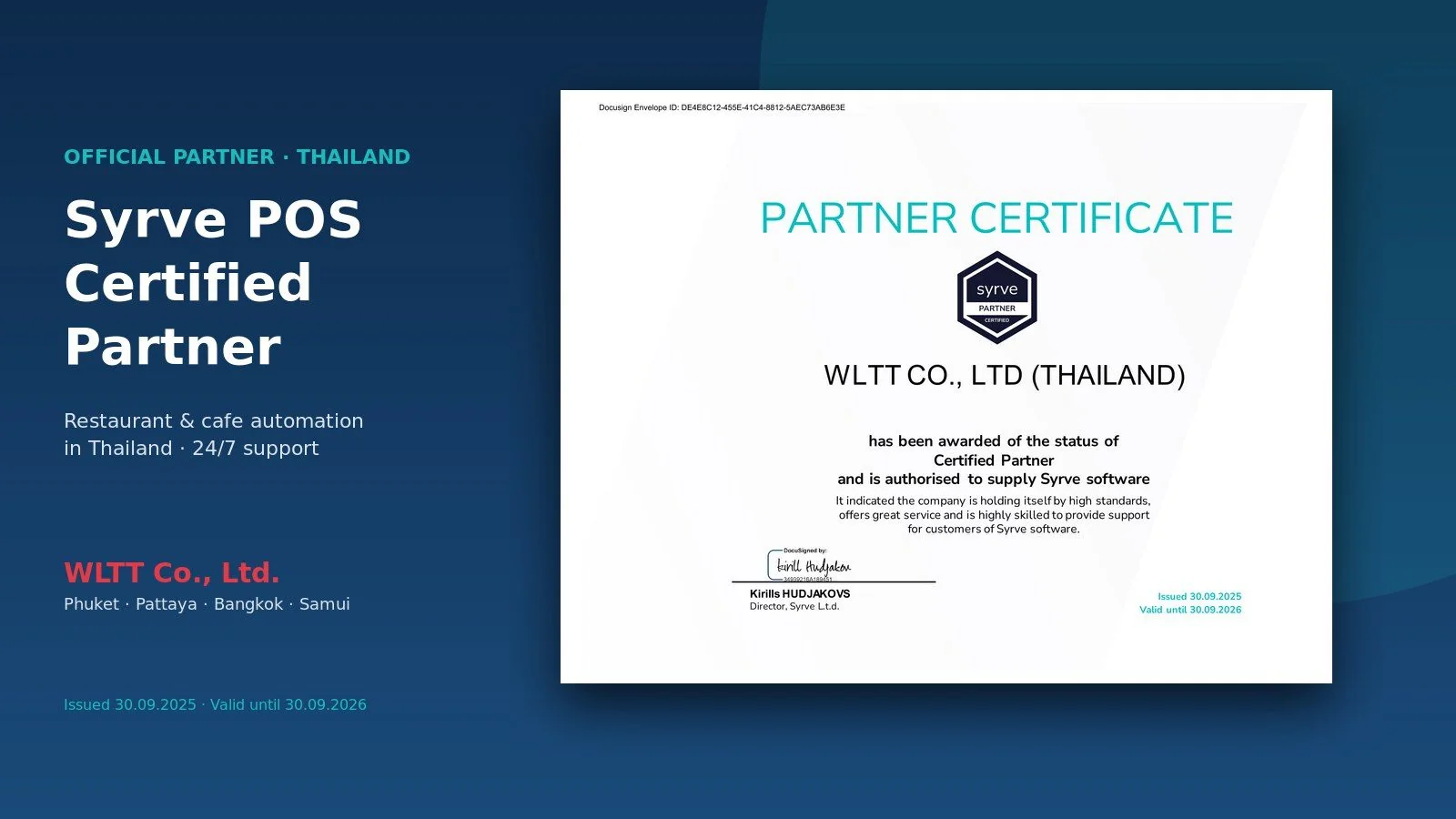
WLTT has been the first official Syrve partner in Thailand since December 2023. We handle turnkey deployments: hardware supply, menu setup, staff training, kitchen printer integration and ongoing support.
Ocha POS: a good start, but a low ceiling
Ocha POS is a Thai-built system aimed at the local market. Thai-language interface, integration with Thai payment gateways, reasonable pricing for a single outlet. For a small café with one register and a simple menu it works well enough.
Problems appear when the business grows. Based on our deployment and migration experience, here is what owners face:
- Basic inventory tracking. Ocha tracks stock levels but does not calculate real-time dish cost by ingredients. Write-offs are approximate — you cannot see how many grams of salmon went into a roll or whether it matches the recipe card.
- Limited customization. Dish modifiers, complex combos, course-based service — all either missing or implemented in a primitive way.
- App instability. App Store reviewers complain about crashes, data loss and the need to re-authenticate several times a day.
- Duplicate order numbers. When multiple devices work in take-away mode, order numbers may duplicate — guaranteed kitchen confusion.
- Weak staff control. No biometric identification, no event-based video surveillance, no detailed operation audit. A serious gap for an owner who cannot stand behind the register 12 hours a day.
- Limited scalability. Fine for one outlet, but managing a multi-venue chain with unified menu, inventory and analytics is not feasible.
Loyverse POS: free — but everything has a price
Loyverse attracts with one key argument: the base version is free. Cashier module, KDS (kitchen display), loyalty programme — all available without a subscription. For a food truck, a single-barista coffee shop or a tiny 5-table café it is a decent starting point.
But a restaurant quickly outgrows Loyverse:
- No built-in payment processing. You need a separate processor with its own fees and contracts — additional hassle and cost.
- Advanced inventory is paid ($25/mo). Even the paid version lacks automatic dish-cost calculation by recipe.
- Employee management is paid ($25/mo). The free version has no access-right segregation at all.
- No course-based kitchen integration. All orders arrive as a flat list — no way to sequence service (salad → soup → main).
- No AI forecasting. Loyverse shows what happened yesterday. Syrve shows what will happen tomorrow — and auto-generates a supplier order.
- No delivery management. If you work with Grab, Foodpanda or LINE MAN, you will enter orders manually or look for a third-party integrator.
- Minimal fraud protection. Without role-based restrictions and operation audit, any employee with register access is a potential risk.
Syrve: a full restaurant management platform
Syrve is not just a cash register. It is a unified system connecting the dining room, kitchen, inventory, accounting, staff and analytics into a single ecosystem. Previously known as Syrve in the CIS, the platform now operates globally under the Syrve brand.
Here is what a restaurant gets:
- Full menu management. Recipe cards with ingredients, modifiers, combos, course-based service, real-time cost calculation.
- Inventory control down to the gram. Automatic ingredient write-off with every sale. Deviations are visible instantly.
- AI forecasting. The system analyses sales history and predicts demand: how much to order for the week, how many staff to schedule per shift.
- Delivery management. Built-in integration with aggregators (Deliveroo, UberEats, Grab). Orders go straight to the kitchen — no double entry.
- CRM and loyalty programme. Bonus cards, RFM segmentation, personalised promotions, referral programme, gift certificates.
- Mobile control. The owner sees revenue, average ticket, kitchen load and stock status from a phone — real-time, from anywhere in the world.
- Multi-language. Cashier interface in Thai, English or Russian. Management panel in whichever language suits you.
- Scalability. One panel for 1 or 50 venues: unified menu, centralised inventory, consolidated analytics.
Comparison table: Syrve vs Ocha vs Loyverse
Below are the key parameters we check during every POS deployment for our clients.
- Real-time dish cost — Syrve: yes · Ocha: no · Loyverse: no
- Automatic ingredient write-off — Syrve: yes · Ocha: partial · Loyverse: no
- AI demand & purchase forecasting — Syrve: yes · Ocha: no · Loyverse: no
- Course-based serving — Syrve: yes · Ocha: no · Loyverse: no
- Delivery & aggregator management — Syrve: built-in · Ocha: no · Loyverse: no
- Cashier identification — Syrve: yes (fingerprint, card, PIN) · Ocha: no · Loyverse: no
- Event-based video surveillance — Syrve: yes (integration) · Ocha: no · Loyverse: no
- Detailed operation audit log — Syrve: yes (immutable) · Ocha: basic · Loyverse: basic
- Multi-location from one panel — Syrve: yes · Ocha: limited · Loyverse: limited
- CRM & RFM segmentation — Syrve: yes · Ocha: no · Loyverse: basic loyalty
- Mobile owner dashboard — Syrve: yes · Ocha: basic · Loyverse: basic
How Syrve protects your restaurant from employee theft
This is arguably the most important section for any restaurant owner who cannot (and should not) stand behind the cashier 24/7. Industry statistics show that internal theft losses reach 4–6% of revenue. For a restaurant doing 1,000,000 THB per month that means 40,000–60,000 THB lost every month — an invisible leak eating into your margin.
Syrve is designed so that every action is traceable, every operation tied to a specific employee, and every deviation from the norm visible to the owner instantly.
1. Biometric identification — no shared passwords
Every employee logs in via fingerprint, personal card or PIN code. No logging in under someone else's account, no passing a password to a colleague, no "I don't remember who was on the register". Every operation — item deletion, discount, refund, cash-drawer opening — is tied to a specific person.
2. Role-based restrictions — a cashier cannot do what a manager can
Syrve lets you precisely configure what each role is allowed to do. A cashier takes orders and processes payments. Deleting an item from a paid bill, issuing a refund, applying a discount above 10% or opening the drawer without a sale — only a manager can do that. The fewer permissions a frontline employee has, the less room for manipulation.
3. Immutable audit log — nothing can be hidden
Every action is recorded in a log that cannot be edited or deleted — not by a cashier, not by a manager, not by an admin. Timestamp, employee, operation type, amount, reason (for deletions and refunds) — everything is captured. If there were 12 item deletions totalling 8,000 THB during a shift, the owner will see it in the report even without visiting the restaurant.
4. Cost and stock control — theft shows up in the numbers
The main defence against product theft is automatic calculation of how much of each ingredient should remain in stock based on dishes sold. Syrve compares theoretical stock (from recipes and sales) with actual stock (from inventory counts). A discrepancy is a signal: either recipes are not being followed, or product is leaving without going through the register.
Example: according to sales data the restaurant should have used 15 kg of salmon in a week. The actual stock is short by 18 kg. Three kilograms "vanished" — and Syrve will show it the morning after the inventory count.
5. Event-based video surveillance — video linked to the operation
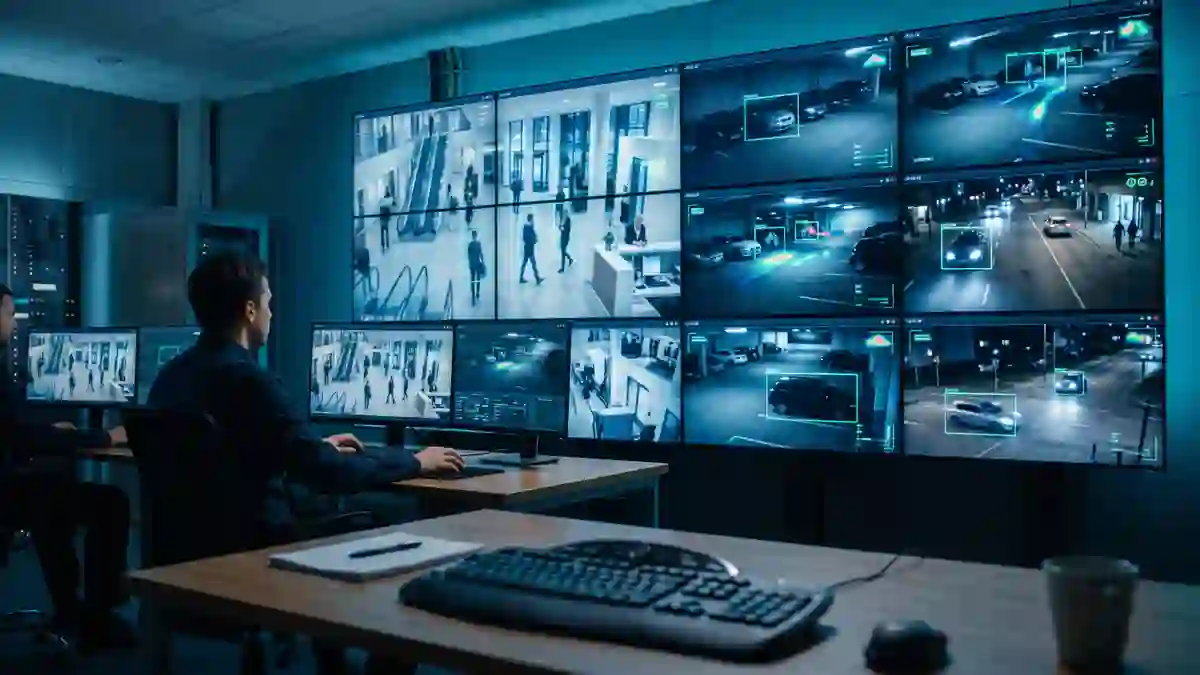
Syrve integrates with CCTV systems. A suspicious operation (item deletion, refund, drawer opened without a sale) is automatically flagged and linked to the video feed from the camera above the register. No need to scrub through hours of footage — the system shows the relevant clip in one click.
As partners of both Hikvision and Syrve, we can set up this integration on request: POS event → camera timestamp → cloud video clip.
6. Discount & loyalty monitoring — detecting schemes
A common scenario: a waiter applies a "regular guest" loyalty card to a random visitor's order and redeems the bonus points for themselves. Or gives an unauthorised discount and pockets the cash difference. Syrve tracks anomalies: if one loyalty card is used 20 times a week, or one cashier gives 5× more discounts than colleagues — the system alerts the owner.
7. Blind cash-out — the cashier does not see the expected total
At shift close the cashier counts cash and enters the amount "blind" — without seeing what the system expects. The discrepancy is recorded automatically. This eliminates "padding": when a cashier sees the expected total and adjusts their count to match it, hiding a shortage.
Common theft schemes and how Syrve blocks them
- "Cancel after payment". Guest pays cash → cashier deletes the bill → pockets the money. In Syrve: deleting a paid bill requires manager authorisation + audit log entry + video clip.
- "Off-register sale". Bartender pours a cocktail without ringing it up. In Syrve: the discrepancy between theoretical and actual alcohol consumption is visible after every inventory count.
- "Swapped item". Cashier rings up a cheaper dish (e.g. salad instead of steak) and takes the cash difference. In Syrve: each dish writes off specific ingredients. If sales show 10 salads but prep consumed ingredients for 10 steaks, the mismatch is obvious.
- "Personal discount". Cashier applies a discount without reason and pockets the cash difference. In Syrve: discounts above the threshold require authorisation. All discounts appear in the report with cashier, time and amount.
- "Friend's loyalty card". Waiter redeems a guest's bonus points to their own card. In Syrve: card-usage analytics flag abnormal activity.
Bottom line: comparing the security approach
Ocha POS and Loyverse record sales. Syrve controls the process — from employee shift login to cash-out. The difference is like having a door lock versus having a full security system with CCTV, sensors and access control.
- Ocha: basic sales recording, minimal audit, no biometrics, no video linking.
- Loyverse: sales recording + basic loyalty, but no ingredient-level cost control, no role restrictions in the free tier.
- Syrve: biometrics + role restrictions + immutable log + gram-level inventory control + event-based video + discount monitoring + blind cash-out.
Who each system is best for
- Ocha POS — a small Thai café with one register, a simple menu, and the owner always on-site. Minimal budget, no plans to scale.
- Loyverse — a food truck, coffee shop or mini-café. Needs a free register with basic analytics. Inventory and staff control are not critical.
- Syrve — a restaurant, café, bar or multi-venue chain. The owner wants to manage by numbers, control food cost, protect against theft and scale without pain.
How WLTT deploys Syrve in Thailand
We do not just sell a licence. A full deployment looks like this:
- Audit of the current system and restaurant workflows.
- Hardware selection and supply: POS terminals, kitchen printers, scanners.
- Menu setup, recipe cards, modifiers, roles and access rights configuration.
- Data migration from the current POS (Ocha, Loyverse, FoodStory, etc.).
- Staff training — cashiers, bartenders, managers, owner.
- Hikvision CCTV integration for event-based monitoring.
- Ongoing technical support after go-live.
«We deploy Syrve not because we earn a commission. We deploy it because after every installation the owner finally sees what is happening in their restaurant — in numbers, not in a manager's retelling.»